

Naasre AI's analysis looks beyond advertising at where cleaning searches are concentrated, how recent estimates have shifted, what separates residential, commercial and grout-cleaning opportunities, and how scope, equipment and recurring work affect the business. Search estimates indicate attention, not customers or revenue; test each acquisition route against your own quotes and completed jobs.
What the search estimates show—and what they do not
Naasre AI compared estimated monthly searches across Cape Town, Pretoria, Johannesburg, Durban and Soweto. Residential cleaning had the strongest search attention in the comparison. Combining the three measured residential keyword groups—general cleaning services, house cleaning services and house cleaning—gives about 820 monthly searches in Cape Town and 320 in Pretoria. Cape Town led the comparison, with Pretoria second.
The latest three-month general-cleaning estimates fell 1.4% in Cape Town, 20% in Pretoria and 40% in Soweto, while rising 15.6% in Johannesburg and 35.3% in Durban. Those percentages sit on estimated monthly bases of 70 to 590 searches, so a change can look large when the underlying count is small. One residential phrasing showed a 106.9% increase after a single month reached 320, following months between 90 and 170; treat that spike as volatility to investigate, not proof of sustained growth.
These are estimated searches, not unique people, bookings or sales, and related queries can overlap. The city comparison is a location-discovery signal, not an instruction to relocate or launch in a particular place. It cannot establish competition, conversion rates, customer budgets or the size of the full market.
Recurring schedules and once-off cleans are different business models
Cleaning offers include scheduled daily, weekly, fortnightly or monthly visits as well as once-off deep cleans, end-of-lease work, pre-sale cleaning and rental changeovers. Commercial contracts may require agreed checklists or a supervisor. The measured search phrases do not tell you which service customers in a city prefer.
Recurring work can make revenue and scheduling more predictable, while once-off deep cleans require more hours per job and a continuing flow of new enquiries. Choose deliberately based on your capacity, cash flow and ability to win repeat work. An undated international market report describes subscription and on-demand models, but it does not establish South African demand, costs or growth.
Scope, trust and equipment determine whether a quote is profitable
A South African cleaning quote-comparison source describes a broad range of work, including end-of-lease, pre-sale, recurring visits, rental-property changeovers, retail, restaurants, hospitality and commercial contracts. It advises customers to confirm who provides products and equipment. Johannesburg operator Clean Queens, for example, advertises reference-checked and insured cleaners, a three-year experience minimum, in-house training and machine-based carpet cleaning.
The competitive bar is not only price: screening, insurance, training and equipment add real costs that a quote needs to recover. Confirm who supplies products and equipment, what the job includes, and whether travel, consumables and specialist tools are priced in before you publish a price. Compete on responsiveness, service area or a focused specialism only when the delivery cost still works.
Grout cleaning is a narrower specialist opportunity
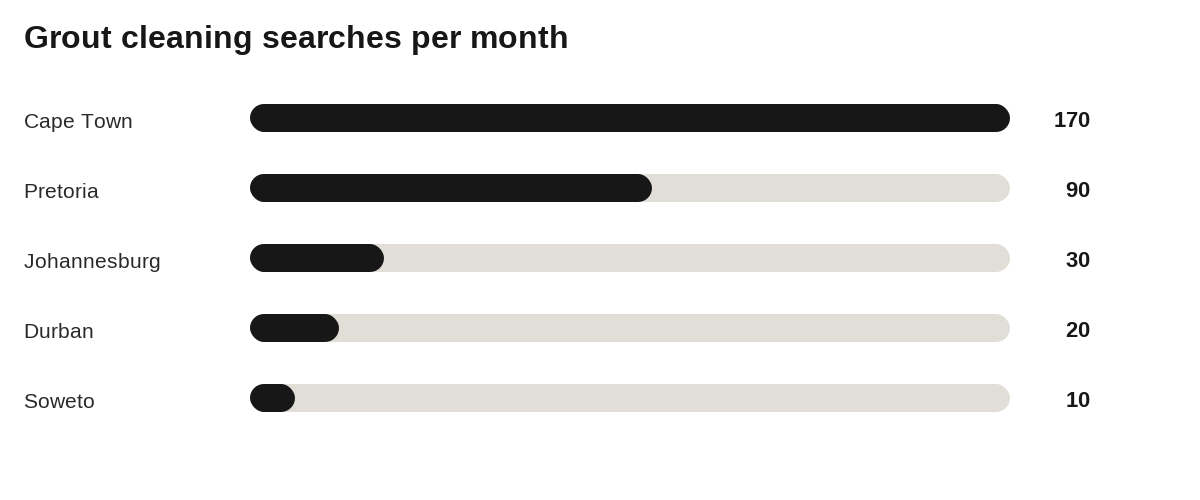
Grout cleaning averaged an estimated 170 monthly searches in Cape Town and 90 in Pretoria, compared with 30 in Johannesburg, 20 in Durban and 10 in Soweto. It is the only specialist task in this comparison with meaningful measured volume in more than one city. For context, general cleaning services recorded 590 estimates in Cape Town and 210 in Pretoria.
That makes grout cleaning worth testing as a distinct service, but the measured attention is too narrow to treat as a proven standalone revenue base. Different equipment, techniques and periodic repeat purchasing are plausible operating assumptions—not facts established by these search counts. Check supplier requirements and use your first enquiries and quotes to test the economics.
Commercial search is limited, but that does not mean the market is small
Commercial cleaning services averaged only 10–20 estimated searches per month in each of the five cities, with several months reported at zero. That makes search ads a limited route into this segment, not evidence that few businesses need cleaning. Companies may buy through referrals, procurement, existing supplier relationships or direct sales.
Test direct outreach and site visits as a primary route: identify suitable offices, guest houses, retailers or complexes, offer a walkthrough, and quote against the site's scope and schedule. Keep commercial prospecting separate from household campaigns and use your own enquiry and quote records to learn which route produces viable work.
Choose an acquisition plan that fits the service you can deliver
For residential cleaning, begin with Google Search ads targeted to the towns or suburbs you can reliably serve. Use service and location terms such as residential cleaning, house cleaning, domestic cleaning and cleaning services in your area. Keep the coverage tight enough that travel time and weekly capacity still make sense. A complete Google Business Profile can also support local discovery.
Present grout cleaning as its own offer, with a matching page or quote form that explains the surfaces you clean and what details or photos a customer should provide. Before spending, decide the service area, weekly job capacity, included scope, products and equipment responsibility, and the next step for requesting a quote.
Track enquiries, quotes, bookings, completed jobs and payments separately for residential work, specialist cleaning and commercial outreach. Compare cost per enquiry and quote-to-booking rates, but decide whether to scale based on completed, paid jobs and the margin left after labour, travel, products and equipment. For help planning your campaign, Try Naasre AI to plan your campaign.
Related questions
01What does the cleaning search data tell a new business?
It indicates where measured search attention is concentrated across five cities, with residential cleaning leading and grout cleaning appearing as a narrower specialist opportunity. Search estimates are not customers, bookings or proof of market size, so validate an offer with actual enquiries and paid work.
02Should I focus on recurring cleaning or once-off jobs?
Search counts do not answer that. Recurring visits can create more predictable schedules; once-off deep cleans and changeovers require a continuing flow of new jobs. Choose based on your capacity, cash flow and ability to win repeat customers.
03Are search ads the best way to find commercial cleaning clients?
Commercial cleaning had only about 10–20 estimated searches per month in each of five cities, so search ads may be limited. Test direct outreach and site visits, but do not infer that the commercial market itself is small from search volume alone.